High eaves, long roof runs and the water that follows
Church buildings often have tall roof lines, wide gables and long eaves that collect more rain water than a small home. In places like Johannesburg, Pretoria, Durban, Cape Town and Polokwane, the roof shape can change how quickly water reaches the gutters, and that affects sizing, bracket spacing and downpipe positions. A hall with a steep pitch and few corners may look straightforward from the ground, yet the actual flow can be heavy during a summer storm or a coastal downpour.
For that reason, the gutter system must be planned as part of the roof edge, not added as an afterthought. A church entrance canopy, nave roof or side passage often needs different lengths and outlets, especially where water from one section feeds into another. Safe access planning matters too. Roofing work at height must be done by competent people with the right fall protection and a proper way to move around the roof line.
- Measure each roof face separately, including returns around towers, porches and transepts
- Check where water will gather and where a downpipe can discharge without causing splashback
- Allow for safe access to eaves, valleys and gutters before work starts
- Plan for maintenance access near stained timber, ceilings and public walkways
The usual material set for a church roof edge
For church projects, the material list normally includes gutter lengths, joiners, stop ends, brackets, downpipes, offsets, shoes, fascia boards and fixing screws. Plastic-steel composite parts suit buildings where the roof edge needs a neat finish and stable performance in changing weather. In coastal areas such as Durban and Cape Town, material choice also has to deal with salt in the air and damp mornings. Inland sites can see strong sun and sharp temperature shifts, so the finish and support system still matter.
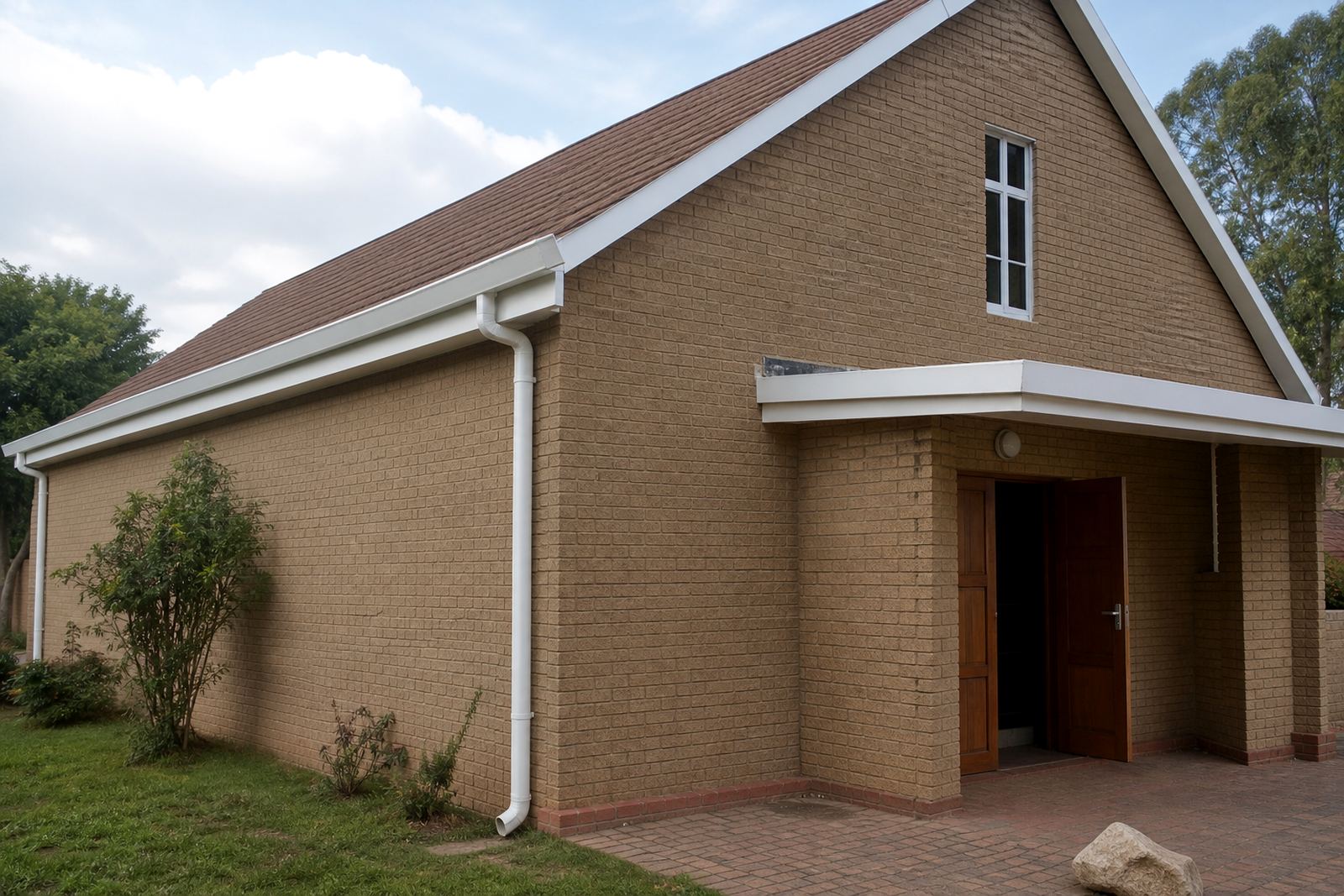
Typical gutter sizes are chosen according to roof area, pitch and the number of outlets. Smaller porches may use lighter sections, while long church roof runs often need wider gutters and more than one downpipe per face. Downpipes are usually positioned near corners, piers or side walls where they can drop cleanly to ground level or into an existing stormwater line. Fascia boards must carry the line straight, because a wavy edge shows quickly on a formal building.
- Gutters: matched to the roof run and expected water load
- Downpipes: selected for outlet position, wall height and runoff direction
- Fascia boards: sized to suit the roof edge and give a straight fixing line
- Brackets: spaced to hold fall and reduce sag over long lengths
Layout decisions that save a church committee trouble later
A good church layout keeps water moving without sending it where people walk, queue or park. On many sites, the front entrance and side passage are the places where water damage becomes obvious first. If the downpipe is placed where worshippers enter, the splash can stain paving and create a slippery patch after rain. If the gutter line is too flat, it holds water and leaves dirt marks under the eaves. A careful slope is enough, but it must be set properly from the start.
Material takeoff is useful on larger churches because long roof runs can eat up fittings quickly. It helps to count every join, corner and outlet before ordering. Some projects also need roofline replacement where old timber fascia has softened or the existing metal edge has bowed. When replacing a roof edge on a live site, work should be phased so access remains controlled around service times and weekday activities.
- Keep downpipes away from main pedestrian routes where possible
- Use enough outlets so water is not forced too far along one gutter run
- Set the gutter fall so it drains cleanly but does not look uneven from ground level
- Check that fascia fixing points are sound before any new system is fitted
Where church projects usually go wrong
The biggest mistakes are usually not about the material itself. They are about poor measuring, weak support and overlooking water movement from one roof section to another. A church may have a central roof and smaller side roofs that empty into the same gutter line. If that flow is not allowed for, the first heavy storm can push water over the lip. Another common mistake is placing brackets too far apart, which allows sagging over time, especially on long straight sections.
Maintenance is often delayed because the building is used on weekends and cleaning access is limited during the week. Leaves, seed pods and dust build up along the gutter line and the downpipes can choke at ground level. In some towns, bird nesting and wind-blown debris add to the problem. A planned maintenance visit is usually easier than a reactive repair after ceiling stains appear. For churches near trees, a simple cleaning routine can save a lot of trouble.
- Too few downpipes for the size of the roof
- Incorrect bracket spacing on long runs
- Leaves and grit left inside gutters after installation
- Water discharging near foundations or entrance paving
Budget ranges for churches and halls
Church budgets vary widely because roof size, access and the condition of the existing fascia all affect the cost. A small chapel with one simple roof face may need only a modest material order and a short installation programme. A larger church with high eaves, multiple roof levels and long perimeter runs will need more brackets, more outlets and more labour for safe working at height. If old fascia boards have to be replaced before the new line goes on, the cost rises again.
As a rough guide, a small roof-edge supply can sit in the lower tens of thousands of Rand, while a larger church with replacement fascia, multiple downpipes and more complex access can move into a much higher bracket. Delivery to branches and areas such as Randburg Supply, Johannesburg Delivery, Pretoria Delivery, Durban Delivery, Cape Town Delivery, Polokwane Delivery, Midrand Supply and Roodepoort Supply is often part of the planning too. The best approach is to measure the roof properly, list the fittings and build the budget from the actual layout rather than guessing from the ground.
- Small chapel or porch section: lower tens of thousands of Rand
- Medium church roofline: often mid tens of thousands of Rand
- Large church with fascia replacement and multiple runs: can rise well above that
- Final cost depends on access, roof height, fittings and the number of outlets
A practical handover for builders and church committees
Plasteel works with builders, contractors and homeowners who need clear material support for church roofs, halls and associated buildings. The practical side of the job is often the most important: accurate measuring, careful ordering, correct falls, and a clean finish around entrances and side walls. Where the roof edge is old or damaged, it is worth checking the fascia, the bracket line and the downpipe route before any replacement begins. That saves time and avoids patchwork fixes that look uneven from the yard.
For church projects, good coordination makes a difference. A builder may need supply only, while a committee may want help with product selection, measuring and delivery timing. Plasteel supports site measuring, material takeoff, product supply, gutter installation, fascia installation, downpipe installation, roofline replacement, leak checks, maintenance visits, builder support, homeowner advice and delivery coordination. On a church roof, those steps are part of the same job because water, access and appearance all have to work together.