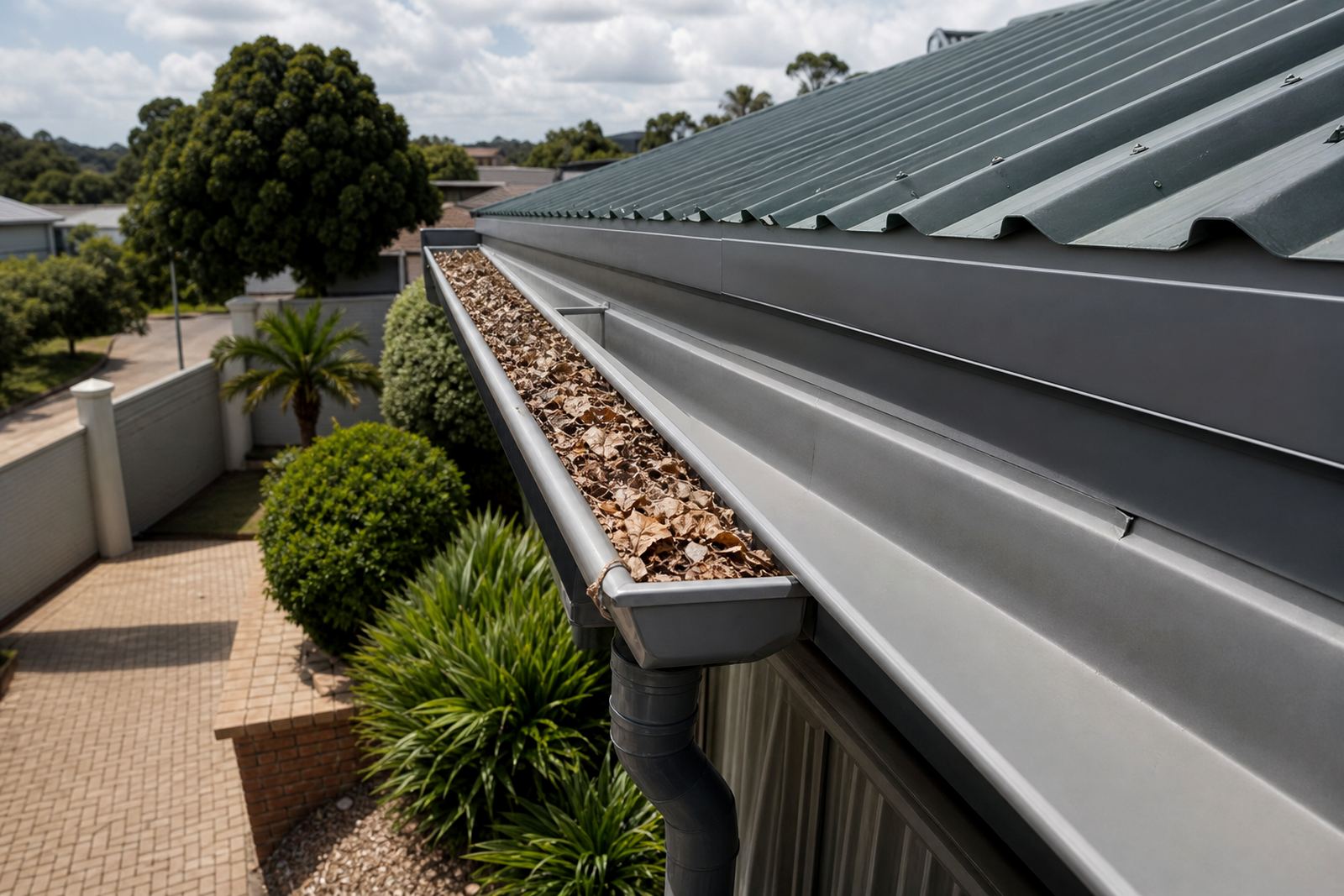
How leaf build-up changes water flow
A gutter is only as good as the route the water can take through it. When leaves collect near joints, corners and outlets, the first problem is not always a full blockage. More often the water starts to slow, swirl and carry fine grit that settles into a wet sludge. That sludge narrows the channel even further.
In a light shower the gutter may seem fine. Then a heavier storm arrives and the water has nowhere to go quickly enough. It spills over the front edge, runs behind the back edge, or forces its way through a weak joint. If the downpipe is already narrow or partially blocked at the top, the overflow gets worse. On coastal properties, trapped moisture also stays wet for longer and can stain fascia boards more quickly.
Where leaves collect first
Some points always catch debris before the rest of the run. These are the spots to inspect first when a gutter starts overflowing or leaving damp marks on the wall.
- Inside corners where two roof sections meet
- Outlets leading into the downpipe
- Low sections where the fall is too flat
- Areas below big trees, especially jacaranda and karee type canopies
- Roofs with nearby fencing or neighbour trees dropping fine leaves and seed husks
In suburbs such as Randburg and parts of Pretoria, winter wind can pile dry leaves into one corner and pack them tight. In Durban, the mix of humidity and fine plant matter can form a heavier paste that holds water for days. Both cases need the same practical response: clear the catch points before the gutter is overloaded.
Signs the gutter is already struggling
Leaf build-up usually leaves a trail before a proper overflow happens. A homeowner may notice the first signs from ground level, especially after a storm.
- Water dribbling over the front edge instead of running to the outlet
- Damp streaks on fascia boards or ceiling corners near the eaves
- A sagging section where wet debris has added extra load
- Plants or grass growing out of settled muck in the gutter
- Gurgling from the downpipe when rainwater should be moving freely
If the fascia board has started to soften or stain, the issue has probably been building for a while. A leak check can show whether the trouble is at a joint, a bracket, the outlet, or a damaged section that is holding debris in place.
The right fall and bracket support matter
Leaf build-up becomes a bigger problem when a gutter does not have the correct fall. A run that is too flat allows water to sit, and standing water catches more leaves. Over time the trapped moisture can pull on the brackets and make the gutter sit even flatter. It becomes a cycle that is easy to miss until the overflow starts.
Good bracket spacing keeps the line steady and helps the gutter hold its shape under water and debris. In a roofline with long runs, it is worth checking that the brackets are secure, the joints are aligned and the outlets are not sitting higher than the surrounding channel. Material choice matters too. Plastic-steel composite gutter and fascia materials are used because they need to hold their shape and cope with weather swings without the same maintenance burden as some older timber or thin metal options.
Maintenance that keeps water moving
Regular gutter care need not be hard. It only has to be steady, especially where trees shed heavily through autumn and the windy months. A clear gutter lets stormwater run through properly and eases strain on the downpipe and outlet.
- Remove loose leaves before they turn into a wet layer
- Flush the gutter and downpipe with clean water after clearing debris
- Check that outlets are open and not narrowed by grit
- Inspect corners, unions and end caps for leaks or movement
- Look for bracket loosening where wet debris has added weight
On commercial roofs, access planning matters. Roofing work at height must be done safely by competent people with the right equipment, especially where access is awkward or the roof pitch is steep. For homes in places like Midrand or Roodepoort, a maintenance visit can often pick up small issues before they turn into fascia repairs or water damage inside the wall cavity.
A Kya Sand example after summer storms
A common local pattern starts with a tree line close to the boundary and a roof facing the afternoon wind. After a few heavy summer showers, leaves collect at the outlet nearest the valley. The gutter looks fine from the driveway, but water begins to hang back in the low point and spill over in one section only. By the time the owner notices the damp patch on the wall, the outlet is already packed with debris.
In that kind of case, the fix is not only to scoop out the leaves. The line has to be checked for correct fall, secure brackets and any joint that may be trapping debris. If the fascia board has been exposed to repeated overflow, it should be inspected for soft spots and staining as well. A clean run, a clear outlet and a sound fascia board work together. Leave one weak point in the system and the leaves will find it.
When repair is better than another clean-out
Some gutters only need a good clean and a fresh check of the downpipe. Others have sections that are warped, dented or repeatedly blocked because the profile no longer drains properly. If the same corner fills up after every storm, there is usually an underlying issue with the slope, outlet position or the condition of the gutter itself.
That is where practical replacement work can save trouble later. Roofline replacement, fascia installation and downpipe installation should be matched to the building and the local weather pattern. A homeowner in Cape Town may be dealing with windblown debris and salt air, while a warehouse in Polokwane may face dust and seasonal leaf fall from nearby trees. From Cape Town houses to Polokwane warehouses, the details differ, but the roofline still has to do one job properly: water must move cleanly from roof to ground without sitting in the gutter first.