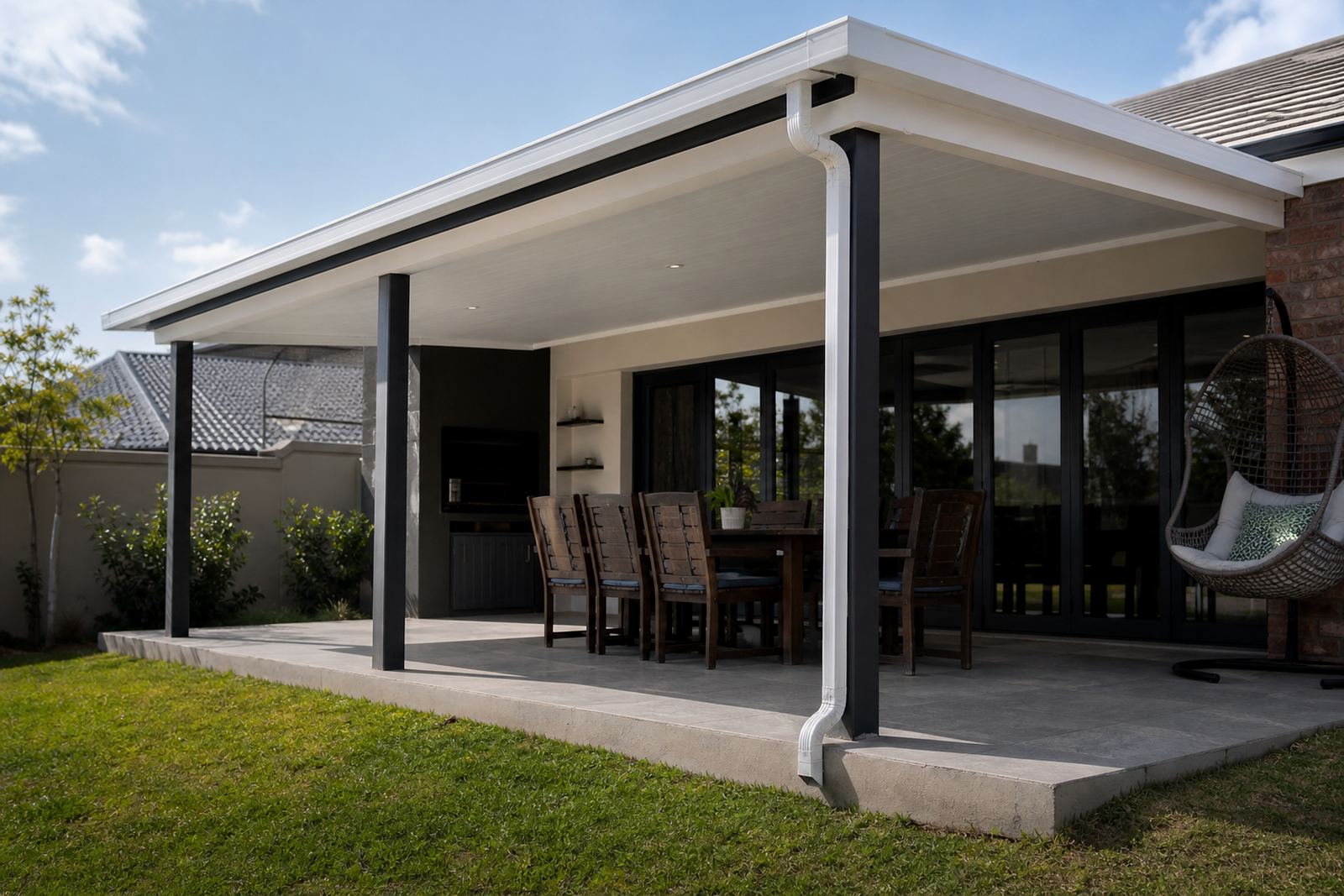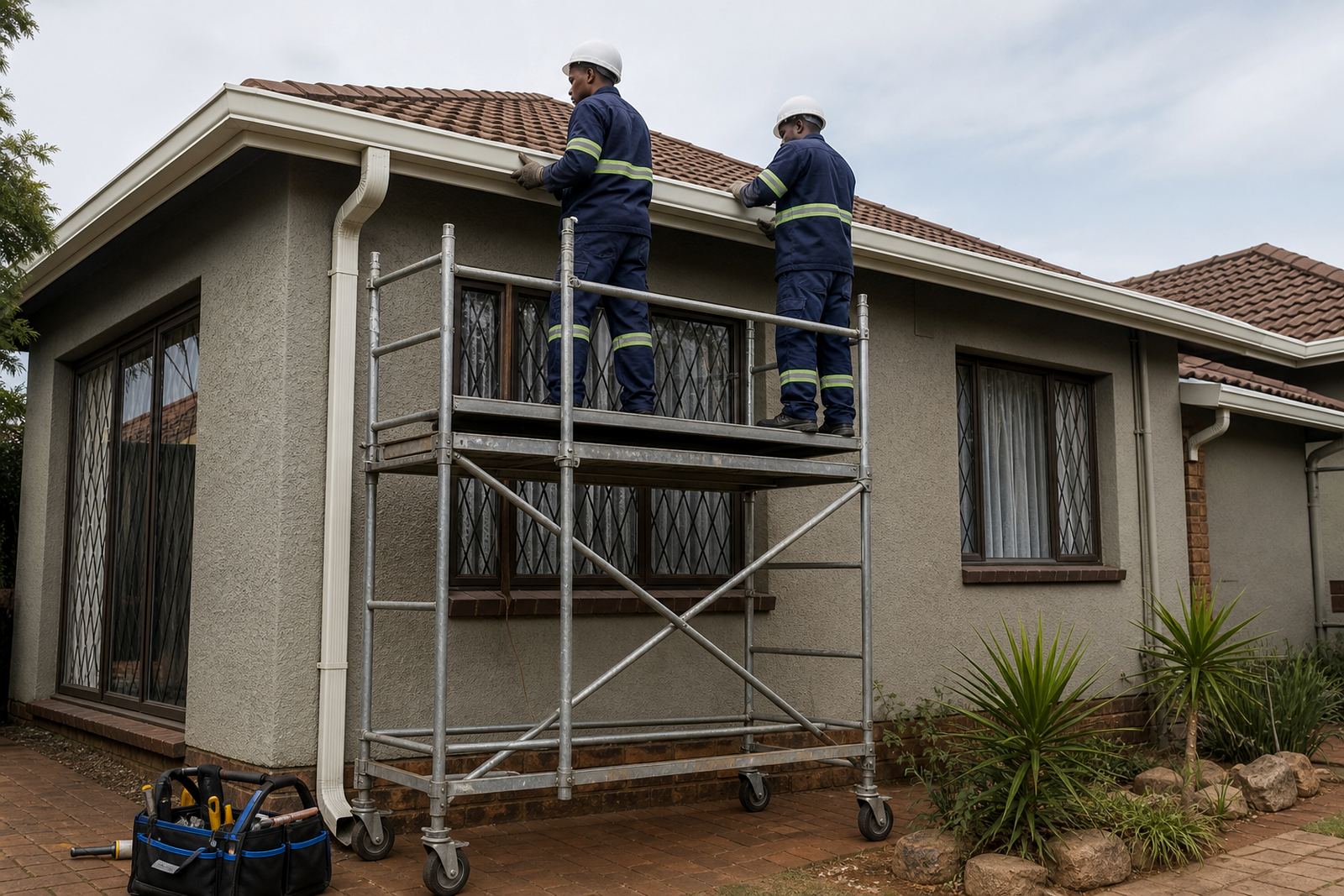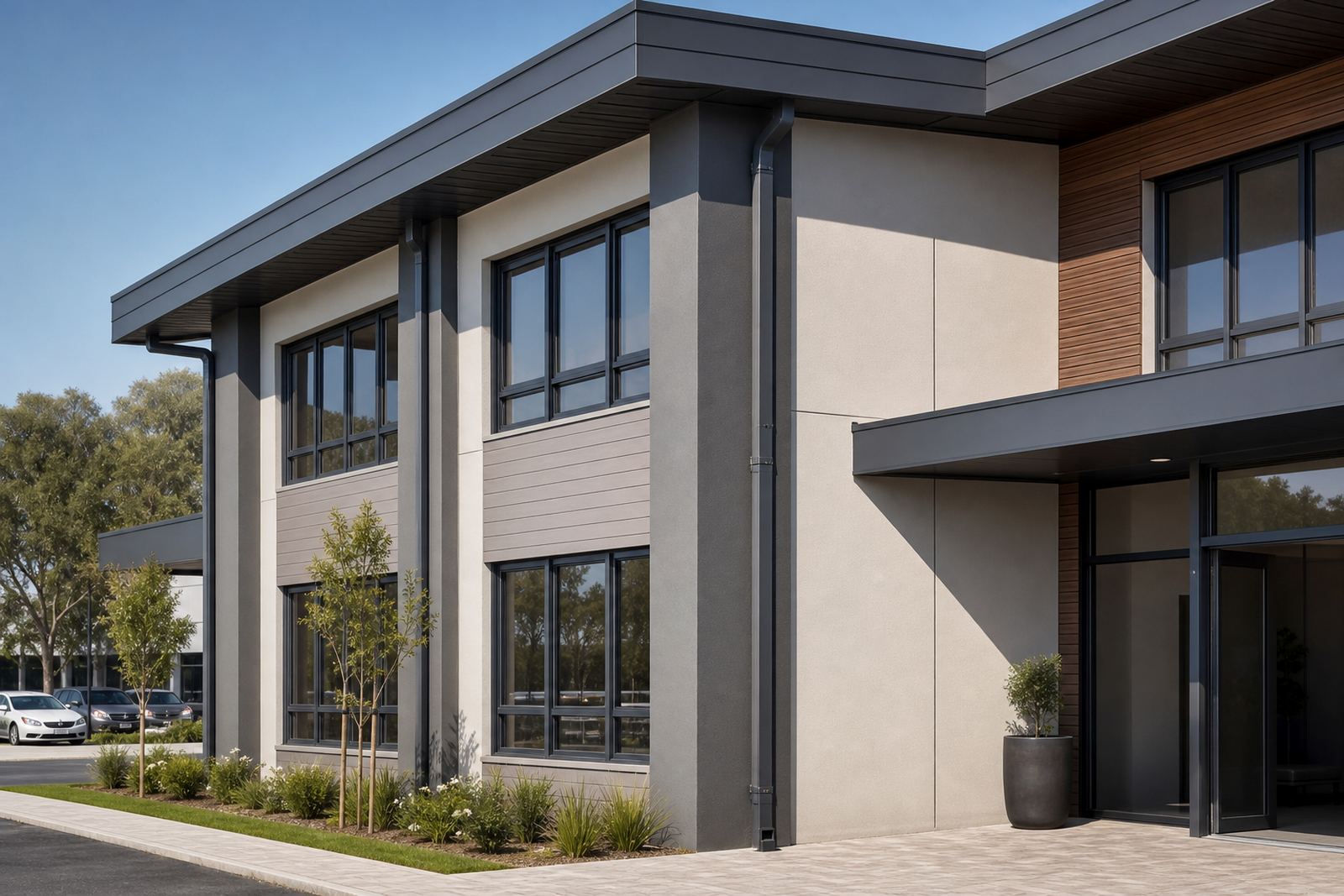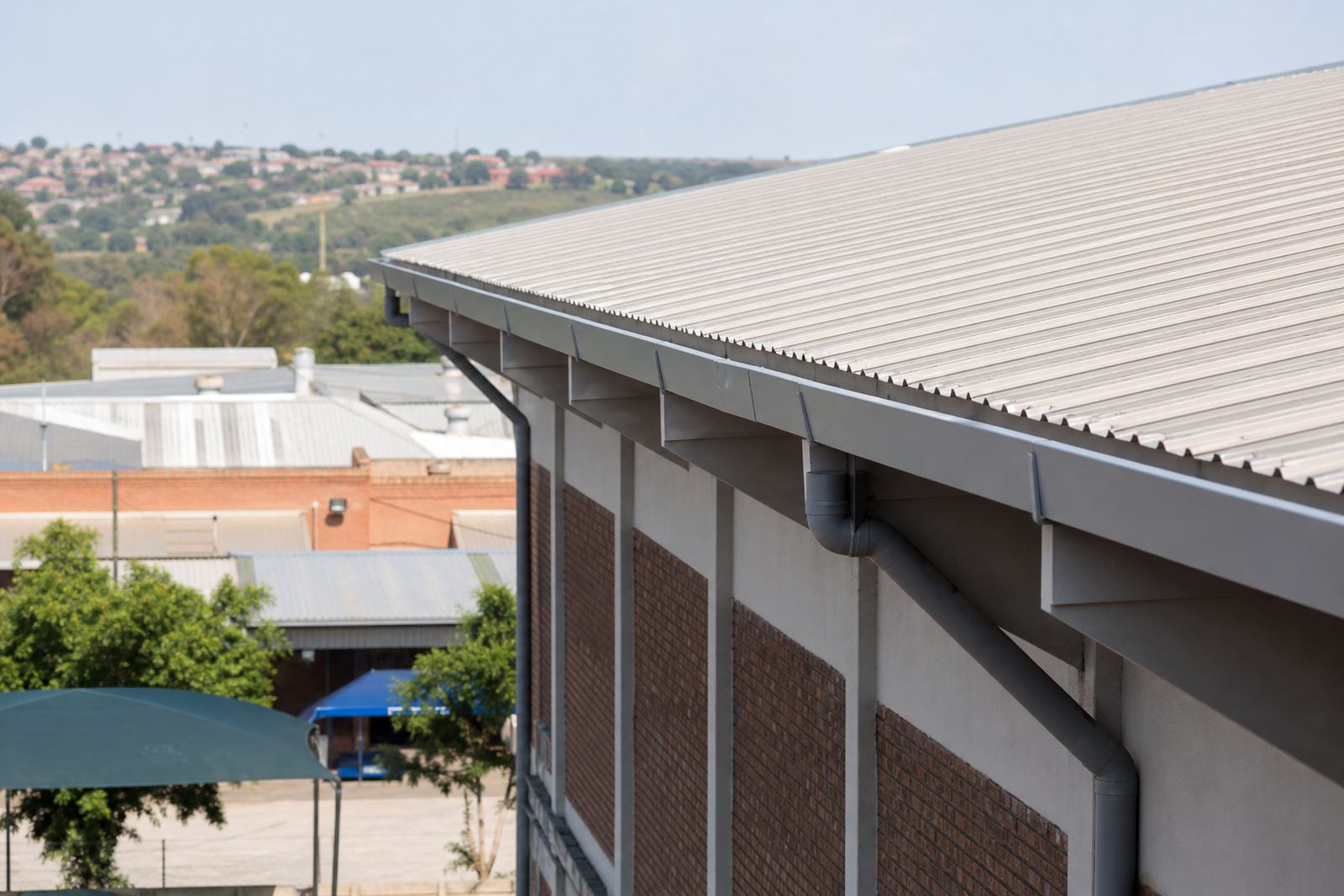
Factory rooflines that need steady drainage
The Benoni site was a working factory with a broad roof span, long eaves and a drainage layout that had to cope with heavy summer rain. The brief was practical: move water off the roof cleanly, keep the roof edge protected, and avoid the overflow issues that had been showing up at certain low points after storms.
The building had a mix of high and lower roof faces, with existing access routes already in use by staff and vehicles. That meant the work had to be planned around operating hours and safe access points. Roof work at height was handled only by competent people using proper fall protection and safe lifting methods, which is non negotiable on any industrial site.
For a factory roof, the details matter. Gutter size, bracket spacing, fall direction and downpipe positions all affect how well the system performs. On this project we treated the roof as a drainage system first and a finish item second.
The brief and the site constraints
The client needed a durable gutter solution that would suit broad industrial roof areas without creating unnecessary maintenance. The existing roof edge had uneven sections and a few areas where old components had been patched over time. There was also limited space for scaffolding on one side of the building, so the install plan had to be neat and controlled.
- Protect the roof edge from repeated water overflow.
- Set the gutters to consistent falls so water moves to the outlets.
- Place downpipes where they would not interfere with loading activity.
- Use fascia components that support a clean roofline and hold fixings well.
- Reduce future cleaning issues by keeping debris traps to a minimum.
We also had to work with the roof pitch and the length of the gutter runs. Long runs on a factory roof can look straightforward from the ground, but if the fall is not set properly, water sits in the line and the system becomes heavy, noisy and prone to leaks at joints. The measure up on this site was therefore just as important as the fitting day.
What we supplied for the roof edge
We supplied plastic-steel composite gutter sections suited to industrial roof spans, together with matching downpipes, fascia boards and fixing accessories. The material choice was driven by the site conditions in Benoni, where heat, dust and seasonal storms can all affect exterior components over time. Composite guttering is useful where a builder needs a practical balance between light handling and solid performance.
The gutter profile was selected for larger roof catchment areas, with joints placed to suit the building lengths and the natural drainage points. Downpipes were sized to suit the water load and positioned to keep discharge away from entrances and busy circulation areas. Fascia boards were used where the roof edge needed a cleaner mounting line and a more stable fixing face.
- Composite gutter sections for long industrial runs.
- Downpipes sized for roof water discharge on broad spans.
- Fascia boards for edge support and a tidier finish.
- Brackets and fixings spaced to suit the load and roof geometry.
- Sealants and connectors matched to the system layout.
On a site like this, a good installation is not only about the material. The line of the gutters, the bracket set-out and the outlet positions all have to work together, otherwise the roof ends up carrying water where it should not.
Setting the falls and fixing the run
We set the gutter falls carefully so that each run moved water toward the outlet points without creating visible dips. That meant checking levels over the full length of the roof edge and adjusting the bracket positions where needed. A factory roof often has more than one drainage direction, so the layout has to be planned section by section rather than copied across the whole building.
Brackets were fixed at practical intervals to support the gutter under load and to reduce movement in windy conditions. The fixing points were checked against the roof structure before installation, because weak anchor points are a common source of later problems. We also made sure the joints were laid out where they could be inspected and maintained with ease.
Downpipe positions were chosen to avoid crossing working areas where possible. In a factory setting, even a well placed pipe can become a nuisance if it blocks access for trolleys, pallets or routine cleaning. The final arrangement kept the lines tidy and left enough clearance around the building edges.
Installation on a live industrial site
The job was completed over two working weeks, with the first week focused on measuring, material preparation and roofline checks. The second week covered installation, outlet connections and final adjustments. The site remained active during the works, so we coordinated access with the factory team and kept the work zones controlled.
Industrial roofs bring their own realities. Dust, machine traffic, parked delivery vehicles and changing weather can all interrupt a normal install rhythm. We adjusted the sequence so that the longest roof sections were handled when access was clear and the weather window was stable. That made the fit cleaner and reduced the need for rework.
- Week 1: site measuring, takeoff and layout planning.
- Week 2: fitting of gutters, downpipes and fascia components.
- Final stage: checks on falls, joints, outlets and discharge points.
Working in Benoni also meant accounting for stormwater flow around the yard. Where roof water discharges too close to the slab edge or loading bay, it creates slippery patches and long term staining. The outlet locations were selected with that in mind.
What changed after the fit
After completion, the roof edge had a more controlled drainage line and the overflow issues at the problem points were reduced. The factory team now has a gutter system that is easier to inspect and clean, which matters on a site that gathers dust and debris from daily operations. The fascia line also gave the roof edge a neater finish, especially where older pieces had been patched over time.
For the client, the main benefit was reliability. The gutter runs now match the roof geometry instead of fighting it, and the downpipes are positioned so water leaves the roof without interfering with movement around the building. That gives the maintenance team a better starting point when storm checks are needed after heavy rain.
Composite materials are useful on industrial buildings because they handle exposure without becoming awkward to work with during maintenance. They are practical for builders and owners who want a system that fits South African weather conditions without needing complicated upkeep.
What we would carry into the next factory roof job
We would handle a similar Benoni factory project the same way again: detailed measure up first, careful fall setting, and a clean outlet plan before any fixing starts. On a roof of this size, the drainage layout should be decided from the building shape, not forced into a standard pattern. That saves time later and gives a better result at the roof edge.
We would also keep the same focus on access planning. Industrial sites need tidy sequencing so the roof work does not interrupt operations more than necessary. A sensible installation is the one that can be inspected, maintained and trusted when the rain arrives hard and fast.
For builders and property owners, the takeaway from this project is straightforward: the gutter system has to be measured for the roof, not guessed. On factory roofs in Benoni and across Gauteng, that is what keeps the water moving and the building protected.
Key facts
| Project type | Industrial factory roof gutter replacement and fascia works |
|---|---|
| Location | Benoni, Gauteng |
| System supplied | Plastic-steel composite gutters, downpipes and fascia boards |
| Key detailing | Set-out falls, bracket spacing, outlet positioning and joint alignment |
| Access and safety | Work at height completed by competent installers with safe access controls |
| Project duration | 2 working weeks |